Wednesday, July 2, 2014

Scars by C. Michael Lorion

Scars (Totem, #1)Scars by C. Michael Lorion
My rating: 5 of 5 stars

Totem: Book 1: Scars by C. Michael Lorion is the story of Kimi, a one eyed Native American woman who has traveled through a "passage" into modern times in search of her brother. She has not made the journey to save her sibling. Kimi and her brother, Achak, do not have anything approximating a close, family relationship. In fact, the book begins with Kimi suffering a serious injury at the hands of her brother and moves on from there as Kimi tries to save the world from her brother's actions.

Lorion has written a page turner with concepts capable of pushing his readers' imaginations while maintaining emotions the same readers can feel. He has combined a mystical Native American story with a tale of suburban relationships, allowing his readers to have legendary characters with magical powers alongside people who could be our neighbors.

The novel takes place in Old Wachusett, Massachusetts during a major blizzard. In addition to the conflict between Kimi and Achack, Lorion gives us David, a college mathematics professor, whose marriage to Connie, the local librarian, has suffered greatly since the death of Julian, one of his sons. David works with an attractive, younger colleague, whose presence isn't helping his troubles at home. David's son Josh, Julian's twin brother, has recently broken up with Abby, the daughter of a minister. The minister is a widower who has gotten into trouble due to his involvement with a married woman. That brief summation touches the main characters, but the novel give us a large cast of people who are all interrelated in a small town way. Lorion does a wonderful job of telling us about his characters through one plot line, then switching to another plot line where those characters are unaware of things we readers now know. This creates excitement as we wonder when and if the truth will come out. Totem: Book 1: Scars is, as its title states, book 1 of a series. So I wasn’t surprised when it introduced a number of sub plots which did not resolve prior to the end of the book. I would have preferred if some of the lines had come to an end while others kept going, but I do look forward to discovering results in the next book.

Lorion writes with a careful attention to detail and gives us plenty of chances to see what’s in the heads of his characters. Here’s an example from Abby’s point of view:

Just the answer she figured she'd get from the One so high and mighty. Not that it mattered. Abby didn't need to look up to an invisible, apathetic God playing hide-and-seek in heaven while his hapless subjects struggled for survival down here on the big blue marble. She didn't need to count on anyone anymore for anything. From now on, everything in her life, everything that would happen to her, and everything that she would do was up to her. She would grab the reigns of her life and take all the responsibility from here on out. No more waiting for her father to fix things, no more wishful thinking that Josh would take her back, and absolutely no more futile attempts at connection to a freakish higher power that only seemed to relish in hiding Himself when people needed Him the most. No more any of that.

Steve Lindahl – author of Motherless Soul and White Horse Regressions

Friday, June 27, 2014

The Secret History by Donna Tartt

The Secret HistoryThe Secret History by Donna Tartt
My rating: 5 of 5 stars

I attended a liberal arts school in the late sixties and early seventies, so I knew people who fit the mold of the main characters in The Secret History: reasonably smart, from well to do families, and generally acting as if our interests were less valuable than theirs. I also knew a few students who were more interested in drugs and alcohol than anything else the university had to offer, including their classes. So Donna Tartt’s setup worked well for me. But in real life I didn’t get to follow the lives of those people as closely as I did in The Secret History where I found their self-centered reactions to the complex situation believable. I also found myself pulling for people who had done some horrible things.

The Secret History is a crime novel from the point of view of one of the criminals. That’s clear from the beginning, so this isn’t a spoiler. Richard Papen is an impulsive young man with a family that doesn’t want him around. He picks his college for arbitrary reasons and picks his major because overcoming the challenge of signing up for Greek is more important than thinking of his future. Right away we see his decisions are a little edgy, but we like and sympathize with him. I find Richard very believable in the context of the novel. I know some reviewers have felt Tartt’s male characters are not male enough. Perhaps Richard thought a little too much about what he and his friends were wearing, but other than that I had no trouble with his masculinity.

Henry Winter and Bunny Corcoran are the two most interesting characters in the book. In a way they flip roles over the course of the book. Although, there are other things going on that push them in unique directions. I can't say much more than that without revealing the plot. Camilla and Charles are interesting in a very broad way, yet I didn't feel I got to know them as well as the other students of Julian Morrow. And every college has its Judy Pooveys, who might be attracted to someone or interested in something that's going on, but always too stoned to care. The teacher, Julian, is also fascinating because he epitomizes the concept of a college environment as a sanctuary where ideas can grow and anything can be discussed, but he has been living this ideal for so long he's lost all concept of the way events stimulated by his ideas can affect him. As the story unfurls, his reactions are wonderful.

The main characters in The Secret History meet as students in a Greek class. This, however, is unlike any language class I ever took. It's more about thinking and philosophy than it is about communication or reading. Here's a quote about that subject. Richard Papen is reflecting on something Julian Morrow has taught him:

The value of Greek prose composition, he said, was not that it gave one any particular facility in the language that could not be gained as easily by other methods but that if done properly, off the top of one's head, it taught one to think in Greek. One's thought patterns become different, he said, when forced into the confines of a rigid and unfamiliar tongue. Certain common ideas become inexpressible; other, previously undreamt-of ones spring to life, finding miraculous new articulation.

It seems like a wonderful thing, to gain a new way of thinking, but it depends on what the new ideas are.

What I liked the most about the book was the slow way Donna Tartt built her plot, carefully giving her readers enough information about her characters to believe the plot was progressing. I read this book and I’m currently listening to the audio of Tartt’s latest novel, The Goldfinch. I waited to finish this one before starting The Goldfinch. They aren’t linked in any way, so the order doesn’t matter, but the style is similar. I’m glad I didn’t try to read them both at the same time. But they are both great reads.

Steve Lindahl – author of Motherless Soul and White Horse Regressions

View all my reviews

Saturday, June 14, 2014

Rules of Civility by Amor Towles

Rules of CivilityRules of Civility by Amor Towles
My rating: 4 of 5 stars

Many of the reviews of Rules of Civility compare the book to The Great Gatsby and I can see that connection. But the story that came to my mind when I read Amor Towles' novel was Breakfast at Tiffany's (the movie more than the novella which I read too many years ago to discuss). Both stories take place in New York and seem to celebrate the city's whirlwind culture. Also, Tinker Grey has a connection to Paul Varjak that is obvious at the end. But the greatest link is in the characters of Eve Ross and Holly Golightly. They are both young women who have come to the city from rural settings determined to make a life for themselves – primarily by finding the right (i.e. wealthy) men.

Katie Kontent is the narrator and primary character in Rules of Civility, so I find it interesting that Towles decided to follow up his novel with a short story collection about Eve rather than continuing with Katie's story. I like that choice. Katie's character was a little too knowledgeable to be believable. She knew the current culture enough to recognize jazz numbers, recite specific lines of poetry by poets she hadn't brought up, and recognize the work of contemporary artists when she happened to see their paintings hanging. She was like a walking culture encyclopedia, but nobody ever commented on her wealth of knowledge. Instead Tinker simply found her a more interesting conversationalist than her roommate. This read as if the author was intruding his own interests on the story.

Towles has received some criticism from other reviewers because Katie seems to think from a male perspective. I agree that her first description of Eve reads as if it was written by a man with a very romantic view of women. But after that I wasn't bothered by thoughts that seemed masculine. Of course, women would naturally be more sensitive to that issue than a male reader.

I listened to the audio version of this book, read by Rebecca Lowman. I found her even toned, slightly apathetic interpretation perfect for the sophisticated feel of this novel, so I would recommend listening to this one.

Steve Lindahl – author of Motherless Soul and White Horse Regressions


View all my reviews

Saturday, June 7, 2014

Laika in Lisan by Maron Anrow

Laika in LisanLaika in Lisan by Maron Anrow
My rating: 4 of 5 stars

In Laika in Lisan by Maron Anrow, the author has built a fictional world apparently inspired by North Korea. Lisan is a country with closed borders, a leader who has manipulated his people to make them worship him, and a son of the leader who is biding his time to gain the power his father enjoys.

While the accuracy of what we know about such a closed off country will always be in doubt, Anrow has created her own world where conjecture and imagination are not only allowed, but probably bring us closer to truth than any list of facts ever could. Also, the villains (both individuals and governments) of Anrow's novel aren't entirely evil and the heroes aren't without their own flaws. This alone brings a truth that can't be found in most news articles.

Lakia is a young woman who lives in the democratic country of Trea, but has always been fascinated by the neighboring country of Lisan. She is also fluent in their language, which apparently is not common among the people of Trea. When Lord Hamin, the autocratic leader of Lisan, decides to open a new university, Laika jumps at the opportunity to become a visiting scholar. Her decision forces her to leave her position as a tutor for the children of a wealthy family and to disappoint her family, especially her father who had fought in a war between the two countries and is still bitter about the experience.

At times I felt Anrow's writing lacked detail, causing the plot to move too quickly and some important scenes to lack credibility. I also thought Anrow told too much of what her characters were feeling rather than allowing her readers to discover their feelings through their actions. One area where this criticism was not true was in Lakia's relation with Rodya, a young man she encounters after she and her guides are attacked on their way to the Holy City. The relationship between Lakia and Rodya grows slowly with twists and turns that are fascinating to read.

Laika in Lisan is a story about making important decisions in a world that isn't black and white. Laika is put in positions she isn't prepared to handle and as a result is consumed by doubt. This is what makes Anrow's characters real and what makes her novel an interesting read.

Steve Lindahl – author of White Horse Regressions and Motherless Soul


View all my reviews

Saturday, May 31, 2014

Don't Tease the Elephants by Jen Knox

Don't Tease the ElephantsDon't Tease the Elephants by Jen Knox
My rating: 5 of 5 stars

Don't Tease the Elephants is a collection of five short stories by Jen Knox the author of Musical Chairs, one of the best memoirs I've ever read. This collection, although short, is packed with emotion and with complex, interesting characters. Knox's people are intelligent and self aware, yet they still learn and change throughout her stories. Meanwhile, there are elements of pain for most of the characters, like irritations to scabbed wounds.

When Pretty People Disappoint is narrated by a young girl who is infatuated with Dory, her baby sitter. Meanwhile Dory has a thing for Ramon, the narrator's brother, who is a player. So this love triangle is a heartbreak triangle from the start, at least on two of the three sides. Dory is a fascinating character who overdresses with religious morality as much as she does with clothing and makeup. It's a story of how people hide behind their chosen images and of how others can see through them.

Nothing is the story of someone who tries to live in two worlds, a family man who secretly patronizes bars and strip clubs. Of course, he can't keep these lives apart, but in his case they come together in a particularly surprising and painful way. In the process he learns something about respect for himself and for the people around him.

Knox makes excellent use of metaphors throughout her work, but in Getting There she adds the twist that her characters are aware of the metaphor. This story is about people who give in to their weaknesses, but manage to maintain hope. The metaphor, which is clear from the first paragraph, is of the Monarch butterflies who can fly thousands of miles to reach their destination. It has other aspects to it, but I can't say what they are without spoiling the story.

Don't Tease the Elephants is available through Amazon in Kindle format.

Steve Lindahl – author of Motherless Soul and White Horse Regressions

View all my reviews

Saturday, May 24, 2014

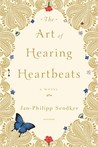
The Art of Hearing Heartbeats by Jan Philipp Sendker

The Art of Hearing HeartbeatsThe Art of Hearing Heartbeats by Jan-Philipp Sendker
My rating: 3 of 5 stars

The concept of The Art of Hearing Heartbeats is fascinating. In this novel a successful American woman drops everything and heads to Burma to discover what happened to her father, who had disappeared years earlier when she was a young girl. This plot provides a chance for the author to make a comparison between a culture based on acquiring material goods and one based more on looking within oneself. Jan-Philipp Sendker does this well, although there are times he slips into cliches and, worse yet, into statements of moral fact that don't stand up to scrutiny. I didn't like the way Julia was told that she shouldn't doubt her father's love, since he was her father. Perhaps fathers loving their daughters is the natural state of things, but it is by no means universal. I also didn't like Sendker's one dimensional portrayal of Tin Win's uncle. But the part that disappointed me the most has to do with two separations. The Art of Hearing Heartbeats is a story within a story and each plot has a separation at its core. Julia's reaction to the similarity of these events didn't make any sense at all.

What I liked the most about this novel was the picture of love found through two people depending on each other or, perhaps more accurately, each person compensating for the abilities lacking in the other. There can be no single definition of love, but this is certainly an interesting one. This is also one of the most quotable books I've ever read. Perhaps this is because Sendker's purpose seems to be to teach rather than simply to tell a story. Here are a couple of examples:

We wish to be loved as we ourselves would love. Any other way makes as uncomfortable. We respond with doubt and suspicion. We misinterpret the signs. We do not understand the language. We accuse. We assert that the other person does not love us. But perhaps he merely loves us in some idiosyncratic way that we fail to recognize.

The true essence of things is invisible to the eyes...Our sensory organs love to lead us astray, and eyes are the most deceptive of all. We rely too heavily on them. We believe that we see the world around us, and yet it is only the surface that we perceive. We must learn to divine the true nature of things, their substance, and the eyes are rather a hindrance than a help in that regard. They distract us. We love to be dazzled. A person who relies too heavily on his eyes neglects his other senses--and I mean more than his hearing or sense of smell. I'm talking about the organ within us for which we have no name. Let us call it the compass of the heart.

Steve Lindahl – author of Motherless Soul and White Horse Regressions

View all my reviews

Saturday, May 17, 2014

Billy Lynn's Long Halftime Walk by Ben Fountain

Billy Lynn's Long Halftime WalkBilly Lynn's Long Halftime Walk by Ben Fountain
My rating: 5 of 5 stars

Every year when Christmas is approaching our local supermarket puts Christmas cards out by the registers. The idea is to gather as many signatures as possible before sending the cards off to some of the troops. On the one hand the effort is nice. At least someone remembers those soldiers are still over there. But on the other hand there's a certain satisfaction in signing one of the cards that is undeserved for such a tiny action. This attitude is the main subject of Billy Lynn's Long Halftime Walk.

A violent fight with Iraqi insurgents has made the Bravo squad into American heroes. So the army has shipped the surviving members back to America to appear in a Dallas Cowboy's halftime show. After the show they are scheduled to return to Iraq to continue their tour of duty. They fully expect to stay there for a long time due to the government's stop-loss policy, which means that any soldier can be kept in the military for as long as they're needed. But for now they're home and Billy Lynn, the young man whose actions during the fight are celebrated the most, gets a chance to see his family and to connect with one of the Dallas Cowboy Cheerleaders.

During their leave in America the soldiers are constantly greeted with “Thank you for your service” and “We support the troops.” But the people who say those things then either pull back into their own lives or, worse yet, exploit the heroes. The owner of the Dallas Cowboys, named Norm Oglesby in Ben Fountain's novel, is the most serious offender as he negotiates the film rights to their story. Again, here is a mixed motivation. Oglesby appears to be honoring the troops, but he's doing so in a way that will earn honor for himself and plenty of money as well.

Billy Lynn's Long Halftime Walk has a second subject which is just as interesting, although a little less unique. When America had a draft there were lots of soldiers sent to war who hadn't volunteered. Without the draft our military is filled with people who either wanted to be there, had thought they would only be spending a couple of days each month at an Army reserve center, or simply had no other options. Billy Lynn is different. He was told he had to join by a judge. But while he is in the army he finds men he admires, especially Shroom, a soldier who was killed in the battle that brought fame to the Bravo troops. He doesn't want to be there, but he also doesn't want to let down the people who depend on him or disappoint a few of the people who admire his warrior status.

Billy Lynn's Long Halftime Walk is wonderful in the way it presents the complicated responses brought about by war, for both the soldiers and the people who stay behind. It's earned the praise it has received.

Steve Lindahl – author of Motherless Soul and White Horse Regressions

View all my reviews